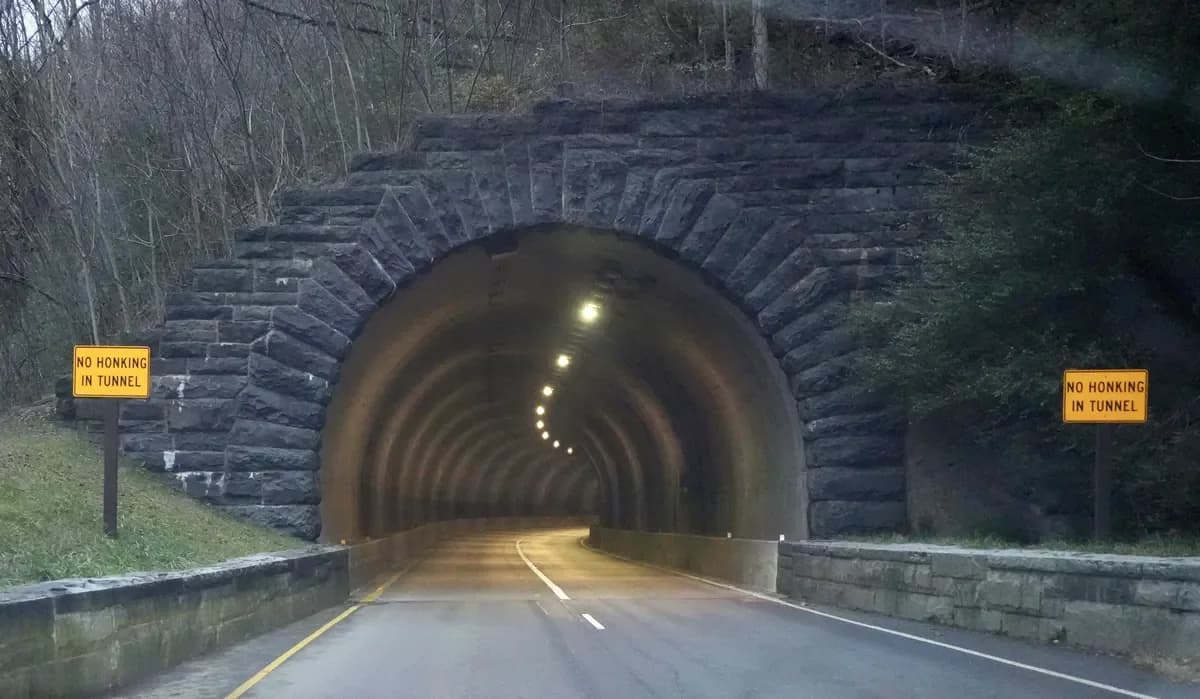
If you’ve ever driven the scenic stretch of US-441/321 known as the Gatlinburg Spur, you’re familiar with the short, dark tunnel that cuts through the mountain.
For decades, this tunnel has been the source of a noisy, unofficial tradition: laying on your horn and enjoying the echoing blast. For many, it’s a nostalgic part of the Smoky Mountain experience.

However, drivers are now greeted by official “No Honking” signs, sparking confusion and a heated debate that has erupted on social media.
Are you supposed to abandon a time-honored tradition? We looked into it, and the answers might surprise you.
The Honking Tradition: A Smoky Mountain Ritual
The tradition of honking in the Spur tunnel is a classic piece of Smoky Mountain culture.
The appearance of the “No Honking” signs led to widespread speculation. Two primary theories have dominated the conversation: that the vibrations could damage the tunnel and that the noise disturbs wildlife.

Myth: Honking Could Cause a Cave-In: Let’s address the most dramatic theory first.
The idea that sound vibrations from car horns could compromise the structural integrity of a tunnel bored through solid mountain rock is, according to engineering principles, doubtful.
Tunnels are constructed to withstand immense pressure and vibrations far exceeding those produced by a car horn.
This specific tunnel recently underwent a multi-million dollar rehabilitation to repair its concrete liner and improve drainage—work designed to ensure its longevity, not to protect it from your sedan’s horn.
Worker Safety and Wildlife The primary and official reason for the recent enforcement of a “no honking” rule was for worker safety.
During the extensive rehabilitation project, crews were working inside and around the tunnel. The constant, deafening echo of horns created an unsafe work environment, making it difficult for workers to communicate and hear potential dangers.
Beyond the temporary construction needs, there’s the standing concern for wildlife.
The Great Smoky Mountains National Park is a sanctuary for a diverse range of animals. The National Park Service promotes respecting the natural soundscape of the park.
Loud, sudden, and unnatural noises can cause stress to wildlife, altering their behavior and potentially forcing them away from their habitats near the roadway.

The Divide: To Honk or Not to Honk?
With the construction project now complete, many drivers wonder if the rule still applies. The signs remain, and the debate continues.
On one side are the traditionalists, who see honking as a harmless and fun part of their vacation that connects them to past memories. They argue that the tradition predates the heavy traffic of today and is a cherished part of the local culture.
On the other side are those who advocate for following the signs out of respect for the park’s rules, its wildlife, and a desire for a more peaceful environment. They argue that the Smokies are a place for natural beauty and that preserving the peaceful soundscape is paramount.
So, while you’re unlikely to cause a rockslide, the question now becomes one of respect for the park’s regulations and for the natural environment it’s designed to protect.
Whether you choose to continue the tradition or embrace the quiet, you’re part of an ongoing Smoky Mountain story.