
Smoky Mountain Files · Crime and Justice
In 2010, Russian authorities questioned Yuri Solovyev about two Gatlinburg coworkers who had been missing for nearly eight years. He gave them the location of Vladimir Yemelyanov and Sufiya Arslanova’s remains.
Gatlinburg officers recovered the remains, the murder weapon and other evidence supporting the case against him. Solovyev had returned to Russia, where the United States could not extradite him. Prosecutors would have to bring the evidence to a Russian court.
Three workers in a tourist town
Yemelyanov and Arslanova shared lodging with Solovyev while all three worked in Gatlinburg in 2002. The released records say little about the victims’ work or daily lives.
In July, Yemelyanov and Arslanova vanished. Solovyev fled before police discovered evidence of violence in the lodging they had shared.
The room on Highway 321
Investigators found the victims’ blood and evidence that someone had tried to clean the lodging.
Investigators learned that Solovyev had acquired a firearm and purchased cleaning supplies. He gave conflicting explanations about his roommates. The victims’ blood was found in his abandoned vehicle. Surveillance cameras later recorded him using their credit cards.
Solovyev had already fled.
Authorities built a homicide case without the bodies of Yemelyanov and Arslanova. A Sevier County grand jury eventually charged Solovyev with both murders, and a federal fugitive warrant carried the search beyond Tennessee.
The fugitive in Moscow
The FBI traced Solovyev to Moscow. Russian authorities took him into custody in 2009.
Russia does not extradite its citizens. Russian law did, however, allow Solovyev to be prosecuted there for crimes committed abroad.
That path required American investigators to turn years of local evidence into a case a Russian court could hear.
The statement that led investigators to the remains
While speaking with Russian authorities in 2010, Solovyev admitted stealing more than $19,000 from Yemelyanov and Arslanova. He also described where their remains had been concealed.
He blamed the killings on an unidentified man called “Alex.” The U.S. investigation had found no such participant.
Gatlinburg officers followed the location information into the mountains. They recovered the remains, the murder weapon and other evidence supporting the conclusion that Solovyev acted alone.
Gatlinburg evidence, Moscow courtroom
The prosecution depended on cooperation between Gatlinburg investigators, the FBI and Russian authorities. Russian investigators and prosecutors traveled to Gatlinburg and spent a week interviewing witnesses and Gatlinburg Police Detective Tim Williams. Evidence gathered in Tennessee was transferred under the U.S.-Russia Mutual Legal Assistance Treaty and presented in the Moscow Region Court.
On December 28, 2012, a jury in the Moscow Region Court found Solovyev guilty of murdering Yemelyanov and Arslanova.
The court sentenced him to 18 years in a strict-regime penal colony. Russia’s Supreme Court later upheld the murder and robbery judgment.
Why the trial mattered beyond Gatlinburg
The Justice Department described the prosecution as the first time Russian authorities tried one of their citizens on U.S. murder charges after an American request to transfer the prosecution.
The case timeline
| Date | Documented event |
|---|---|
| July 2002 | Yemelyanov and Arslanova are killed in Gatlinburg. Solovyev flees. |
| June 2004 | Federal authorities obtain a fugitive warrant; the international search continues. |
| 2005 | A Sevier County indictment charging two murders is unsealed. |
| 2009 | Russian authorities take Solovyev into custody. |
| March 2010 | Gatlinburg police recover the victims’ remains after receiving location information. |
| December 28, 2012 | A Moscow Region Court jury returns a guilty verdict. |
| January 31, 2013 | The court imposes an 18-year strict-regime sentence. |
| April 2013 | Russia’s Supreme Court leaves the conviction and sentence in place. |
What the public record preserves
The released court and law-enforcement records document the prosecution in detail but preserve little about Yemelyanov and Arslanova beyond their names, their seasonal work and the place they were living in 2002. Their names should remain attached to the case: Vladimir Yemelyanov and Sufiya Arslanova.
Sources and reporting notes
- U.S. Attorney’s Office, Eastern District of Tennessee: Russian national convicted of 2002 Gatlinburg double homicide.
- Knoxville News Sentinel, “Remains believed to be missing Russian immigrants,” March 6, 2010. The newspaper’s legacy archive currently returns a server error; the bibliographic citation is retained without sending readers to a broken page.
- Jamie Satterfield, Knoxville News Sentinel, “Detective: Decade-long quest for justice in Gatlinburg murders ‘finally over,’” January 10, 2013. The newspaper’s legacy archive currently returns a server error.
- Rossiyskaya Gazeta: Moscow Regional Court imposes an 18-year sentence.
- Rossiyskaya Gazeta: Russian Supreme Court upholds the judgment.
- Library of Congress: Carol M. Highsmith Gatlinburg street photograph and rights record.
- National Park Service: public-domain mountain-road photograph and rights record.
Method: The charging evidence, international process and verdict follow the Justice Department release. Contemporaneous reporting supplies the 2010 recovery date. Russian court reporting confirms the sentence and appeal.
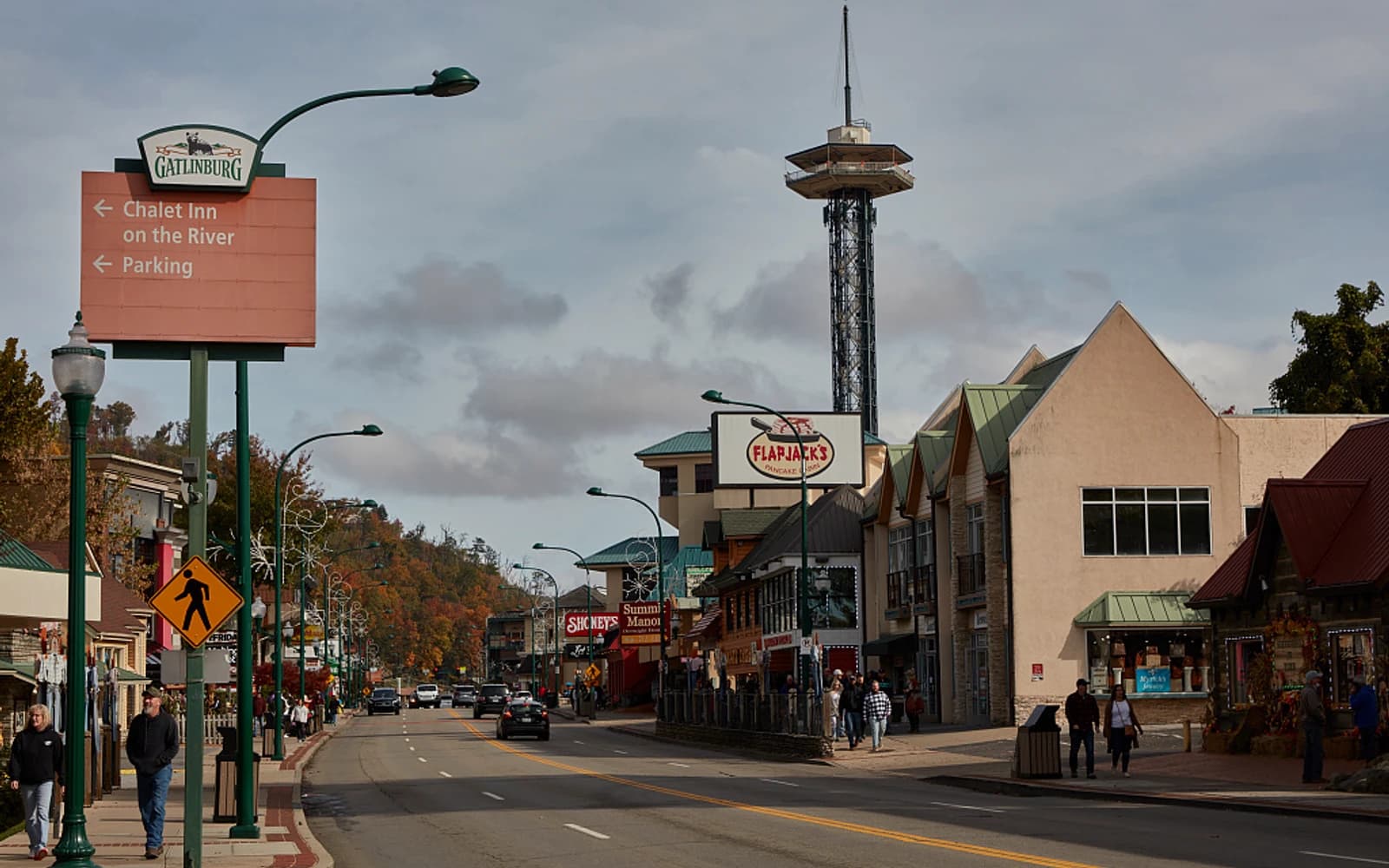
Image rights: The hero is a modern Gatlinburg street photograph by Carol M. Highsmith; the Library of Congress lists no known publication restrictions. The road image is a public-domain NPS staff photograph used as geographic context. Neither depicts a crime scene.
Trauma note: This account omits graphic treatment of the victims’ remains. Those details add shock without improving the explanation of the evidence or prosecution.
Corrections: We update Smoky Mountain Files when stronger records become available. Send documented corrections through the contact page with the record supporting the change.